SPONSORED BY: Softing Industrial Automation
How a flexible deployment strategy supports standardized and secure industrial data access
Production data must be made reliably available to MES, ERP, analytics, and cloud applications. OPC UA provides the standardized, platform-independent foundation for this exchange: it enables interoperable access to industrial data while supporting security mechanisms such as encryption, authentication, and certificate-based trust. Yet the value of the standard also depends on how the integration layer is deployed and managed. Whether it runs on Windows, in a containerized environment, or on a dedicated hardware gateway is determined by strategic objectives, cybersecurity requirements, and existing plant infrastructures.
Heterogeneous infrastructures are the norm
Industrial companies typically operate different IT and OT architectures side by side. One plant may rely on established Windows systems, while another already uses containerized applications. Retrofit projects, individual machines, or segregated production areas may require compact hardware gateways. This diversity reflects different modernization cycles and local requirements, making complete infrastructure standardization neither realistic nor economical.
Different solutions increase complexity
Complexity grows when each deployment model requires a separate connectivity product. Although these solutions may perform similar tasks, they can differ in configuration, administration, update processes, and security mechanisms. OPC UA certificates and trust lists may then have to be handled in different ways at each site. Every additional variant increases lifecycle-management effort and makes it harder to apply consistent security and governance policies across the enterprise.
One OPC UA platform for multiple deployment models
Softing Industrial’s SDEX Suite provides a unified integration foundation for these heterogeneous environments. It connects controllers and CNC systems from leading manufacturers, including Siemens SIMATIC and SINUMERIK, FANUC CNC, and Allen-Bradley ControlLogix, and makes their data available to higher-level applications through OPC UA. Existing OPC UA servers can also be integrated into the data architecture. This creates a consistent standards-based interface even when the underlying controllers, protocols, and operating environments differ.
Within the integration layer, production data can be aggregated, structured, and exposed to OPC UA clients such as MES, SCADA, historians, and analytics applications. OPC UA therefore serves as more than a transport mechanism: its information-oriented approach helps applications consume industrial data in a consistent context. Where publish/subscribe connectivity to cloud or IIoT environments is required, MQTT complements OPC UA as an additional northbound interface.
The platform supports OPC UA security through encrypted communication, certificate management, and access control. These capabilities help companies establish controlled data access between OT and IT without exposing controllers directly to business or cloud applications.
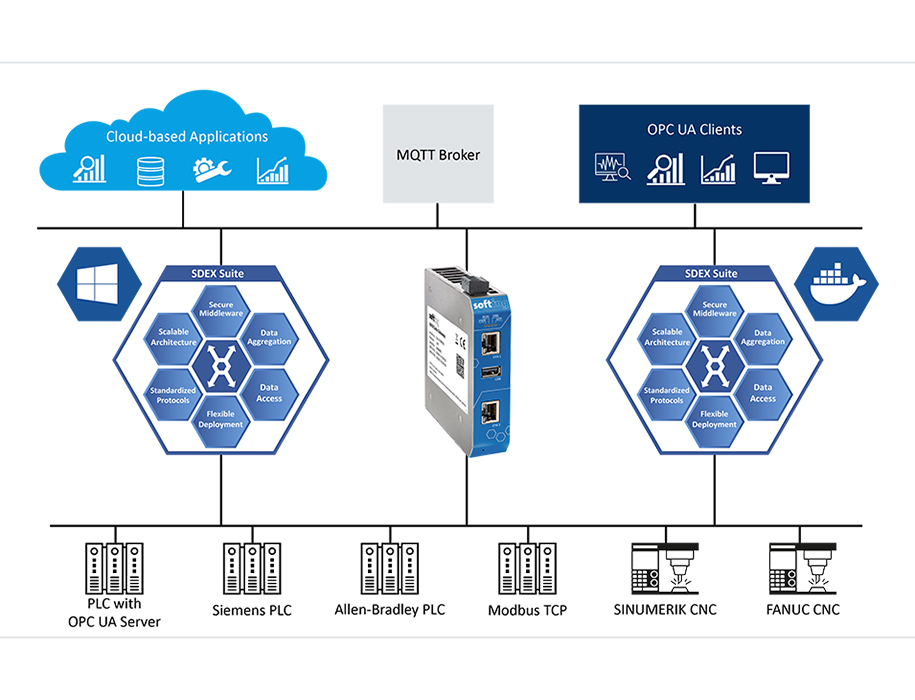
SDEX Suite application architecture: standardized OPC UA access to production data across Windows, Docker, and hardware deployments. Source: Softing Industrial
SDEX Suite can be deployed as Windows software, in a Linux/Docker environment, or as a hardware gateway. The OPC UA interface, integration mechanisms, security functions, and configuration principles remain consistent across these deployment variants. Each plant or production area can therefore select the operating model that fits its infrastructure while participating in the same company-wide data architecture.
Standardization without replacing the infrastructure
A flexible deployment strategy allows existing systems to remain in place while the integration layer is standardized around OPC UA. This reduces administration effort and supports consistent data access across sites and system boundaries. The result is not a single operating environment everywhere, but a unified, secure, and scalable OPC UA architecture that can evolve with the company’s IT and OT landscape.
Further information: https://go.industrial.softing.com/l/918823/2026-08-27/3jmp3b