Welcome to the Cloud corner! Although OPC UA is widely recognized for secure and reliable data exchange in industrial automation, its true power lies in its rich semantic information modeling capabilities.
There is so much to explore that each of our upcoming newsletters will dive deeper into one specific topic – today it’s all about the UA Library.
Executive summary:
The UA Cloud Library – the semantic backbone of OPC UA is not only the world’s largest repository of OPC UA–based industrial automation information models. More than a library, it provides an intuitive UI to create, manage, and instantiate models in a centralized, scalable environment, versioned, and accessible in a centralized, scalable database environment.
UA Cloud Library – the semantic backbone of OPC UA
The OPC Foundation accelerates interoperability of OT and IT systems using OPC UA – especially by making OPC UA Information Models and Companion Specifications available everywhere. UA Cloud Library is the global, queryable online repository for those models.
INTRODUCTION
Industrial data becomes truly reusable only when its meaning travels with it. OPC UA Information Models capture that meaning – assets, structure, types, relationships, and domain semantics. The UA Cloud Library brings these models into the cloud as a searchable, governed catalog, so edge or cloud applications and services can use standardized semantics across plants, vendors, and ecosystems.
SEMANTIC DATA MODELS IN THE CLOUD
Maintaining OPC UA Information Models and Companion Specifications in the cloud to utilize the context of data in edge or cloud services, is a core requirement for manufacturers. UA Cloud Library is the open, cloud-independent implementation of this requirement.
WHY SEMANTIC MODELS IN THE CLOUD MATTERS FOR OT/IT CONVERGENCE
- Discovery happens too late, today.
Clients typically discover and learn a model only after browsing a live OPC UA server – too late for solution design and automation. - Onboarding & dashboards are slowed by “semantic guesswork.”
Teams reverse engineer machine semantics asset-by-asset, tag-by-tag, delaying scalable edge and cloud analytics. - Companion Specifications are shared as files.
Sharing OPC UA Companion Specifications as files makes them hard to search, version, and reuse consistently across edge and cloud apps. - The cloud also needs cloud APIs.
The Cloud Initiative emphasizes cloud-scale interoperability, which also requires standardized application programming interfaces, identity, and automation – beyond what simple file downloads can provide.
THE SOLUTION
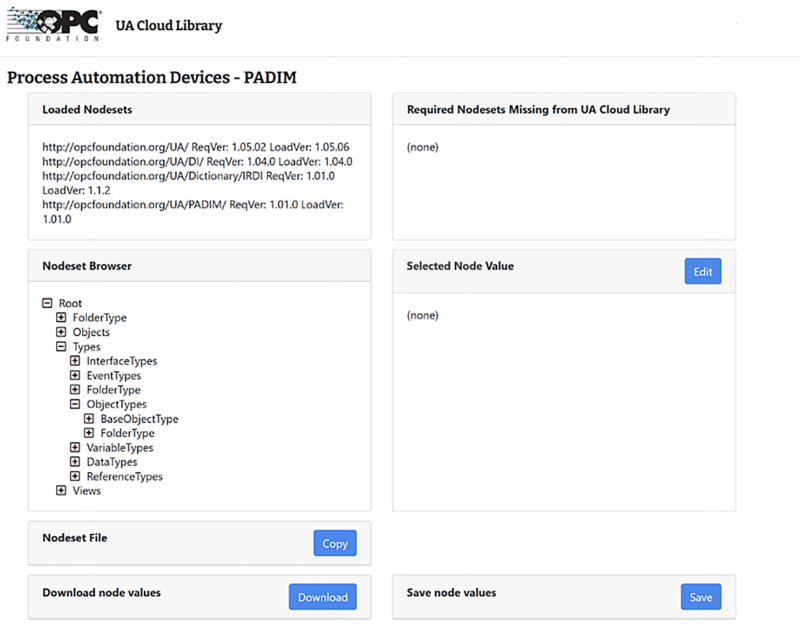
UA Cloud Library is the OPC Foundation’s standardized mechanism to publish, find, and retrieve OPC UA Information Models on an Internet scale. It provides a mandatory REST API and a browser UI. The specification was developed by an OPC Foundation Joint Working Group with CESMII, and is available as an open-source reference implementation, as well as a global instance hosted by the OPC Foundation (https://uacloudlibrary.opcfoundation.org). In addition, many manufacturers host their own instance on the edge or in the cloud, leveraging the pre-built Docker container image, available free of charge from the OPC Foundation through the GitHub Container Registry.
WHAT IT ENABLES IN THE OPC FOUNDATION CLOUD INITIATIVE REFERENCE ARCHITECTURE
- Design time semantics: cloud apps can be configured using Companion Specifications before connecting to production assets, thus, facilitating offline engineering of the proposed instance.
- Interoperable pipelines: a shared model catalog supports consistent schemas and context across ingestion, storage, analytics, and AI apps in the cloud architecture.
- Public + private ecosystems: a public, global repository for community models and private instances for OEM/enterprise models – aligned with the OPC Foundation Cloud Initiative’s openness and interoperability goals.
- Host for OPC UA types and instances: both OPC UA types and instances can be hosted in the OPC Foundation Cloud Initiative, paving the road for interoperability; not just for semantic metadata, but also for instances of for example, the Digital Product Passport (DPP).
BENEFITS
- Build analytics earlier. Set up dashboards and analytics pipelines during the design phase, well before connecting to the plant’s assets for the first time.
- Scale interoperability through reuse. Reuse main-expert models to standardize semantics across assets, plants, partners, and cloud providers.
- Reduce integration risk. Simulate, test, and verify information models early—before the asset is even built.
- Enable richer cloud context. Full-fidelity information models in the cloud support deeper semantic enrichment than telemetry metadata alone (e.g., for time series and analytics engines).
In short: UA Cloud Library is one of the OPC Foundation’s open, standardized building blocks – supporting cloud scale interoperability without vendor lock in.
MORE INFORMATION
- OPC Foundation Cloud Initiative overview:
https://opcfoundation.org/cloud - Overview & use cases:
https://opcfoundation.org/markets-collaboration/cloudlib - Public instance:
https://uacloudlibrary.opcfoundation.org - Open-source reference implementation:
https://github.com/OPCFoundation/UA-CloudLibrary - Example cloud integration:
https://learn.microsoft.com/en-us/azure/iot/tutorial-iot-industrial-solution-architecture#uacloud-library