SPONSORED BY: Integration Objects

Modern desalination plants rely on a wide range of PLCs, analyzers, sensors, and control systems. While each device plays a critical role, their lack of interoperability creates operational blind spots and limits the adoption of advanced optimization strategies. To unlock real AI-driven efficiency, plants first need a unified, secure, and structured data environment – which is exactly what OPC UA and SIOTH® deliver.
Core Challenges in Today’s Desalination Environments
- Scattered Control Systems
Water desalination facilities typically operate with heterogenous PLC brands, proprietary analyzer protocols, and standalone SCADA systems. This fragmentation prevents operators from having one unified view of the process and makes cross-site, cross-system automation nearly impossible.
To break this fragmentation, desalination plants require a single, vendor-agnostic OPC UA capable of aggregating all operational data into one trusted environment.
- Issues Securing OT Data Collection
Many legacy OT devices were never designed for modern cybersecurity requirements. Collecting data from them – especially over various industrial protocols – introduces risk.
Ensuring secure, authenticated, and encrypted communications across all equipment is now essential but difficult without a standardized framework.
- Lack of Insights Due to Fragmented Data
Because data are scattered across devices, formats, and proprietary systems, users struggle to access consistent information. This makes it nearly impossible to build meaningful dashboards, detect anomalies early, or support data-driven decisions. As a result, optimization efforts, AI models, and predictive strategies remain out of reach.
SIOTH® as the OPC UA Universal Integration Layer
To address these challenges, SIOTH® provides a unified industrial integration layer built around OPC UA: the OPC UA Universal Sever.
SIOTH® OPC UA Universal Server aggregates data from all PLCs, analyzers, sensors, and SCADA systems – regardless of vendor or protocol – and exposes everything through a single standardized OPC UA endpoint.
This OPC UA layer ensures:
- Vendor-agnostic connectivity
- Secure, encrypted communication
- Consistent access to real-time operational signals
- A scalable foundation for plant-wide interoperability
By becoming the OPC UA “single source of truth”, SIOTH® removes the complexity of dealing with multiple proprietary systems and establishes a unified operational backbone for the entire plant.
SIOTH® Data Model: Acting as a UA Companion for Desalination
Once data from pumps, valves, analyzers, PLCs, and SCADA systems is unified, SIOTH® OPC UA Universal Server applies its structured industrial data model. SIOTH data model facilities the implementation of UA companion specifications for industry equipment, providing consistent naming, typing, and context for all process variables.
Desalination plants are often a mix of equipment from different vendors, leading to inconsistent tag names, data formats, and structures. SIOTH® OPC UA Universal Server solves this by creating a common semantic layer that standardizes assets– so all pumps, membranes, flowmeters, and chemical dosing units are represented in a consistent, hierarchical model.
Key Benefits:
- A common Semantic Layer: All equipment and process variables are uniformly represented, regardless of vendor or protocol, making it easy for end users to compare, monitor, and manage operations across multiple sites.
- Simplified Engineering and Data Governance: With a standardized model in place, new devices can be onboarded quickly, data is easier to manage, and engineers can maintain consistent naming and attributes
- Human and AI-Ready Insights: Operators gain a clear, structured view of the process, while AI and machine-learning systems can directly use the standardized data for anomaly detection, predictive maintenance, and optimization.
- Fast Multi-Plant Scalability: The model can be replicated across multiple plants and vendors, enabling consistent KPIs, and seamless IT-OT-IIoT integration – without rebuilding the data structure for each site.
In short, SIOTH® OPC UA Universal Server transforms raw, heterogenous data into a structured semantically rich industrial information model enabling UA Companion adoption. This makes operations more transparent, analytics-ready, and scalable – allowing plants to leverage advanced monitoring, AI, and multi-site management with ease.
How Structured Data Enables Seamless AI Deployment
Once data unified through OPC UA’s secure, standardized streams and structured with the SIOTH® data model, deploying AI becomes significantly simpler. There is no longer a need to spend hours manually mapping variables, cleaning inconsistent datasets, or handling vendor-specific formats. Instead, AI can immediately access well-organized, reliable data.
What AI Gains from Structured Data:
- Clean, organized Datasets: Every variable is normalized and clearly labeled, eliminating inconsistences that often slow down AI development
- Unified Process Variables: Data from pumps, valves, membranes, and sensors are represented in a consistent semantic layer, making it easier to correlate signals and understand process behavior.
- Real-time Signals: AI can consume live operational data directly, enabling advanced monitoring, anomaly detection, and predictive control.
- Historical Trends Already Normalized: Past performance, long-term trends, and time-series data are ready to feed models without additional processing.
By providing this structured, standardized foundation, SIOTH® drastically reduces development time, lowers engineering overhead, and accelerates the adoption of predictive maintenance, process optimization, and advanced analytics across desalination plants.
With SIOTH® and OPC UA working together, AI deployment moves from a complex, error-prone task to an efficient process, turning operational data into actionable insights.
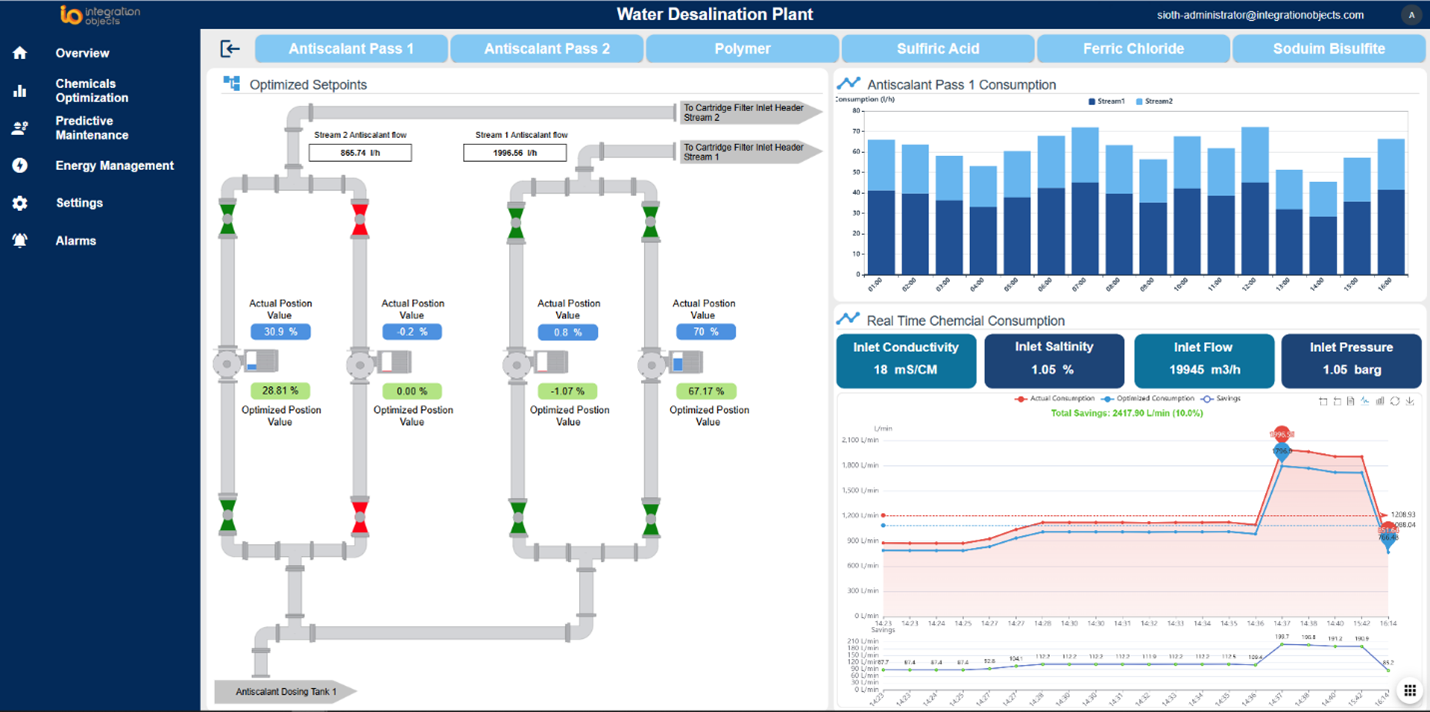
Application Example: Chemical Optimization in Desalination
Conclusion
By unifying scattered control systems, securing OT data collection, and providing a structured data model that simplifies AI development, SIOTH® and OPC UA form the foundation for intelligent desalination operations.
The result is a plant that is more transparent, more efficient, and fully prepared for AI-driven optimization at scale.