SPONSORED BY: Takebishi

- Why OPC System Redundancy Matters
In modern industrial automation, OPC systems play a critical role in transferring real-time data from devices to applications such as SCADA, MES, and BI tools. Unplanned interruptions can quickly lead to costly production delays and loss of process visibility. That’s why redundancy is not a luxury – it’s a core design principle. To achieve high availability, manufacturers need robust strategies that ensure communication remains intact even when hardware, networks, or devices fail.
- Configuring Redundant Communication with DeviceXPlorer OPC Server
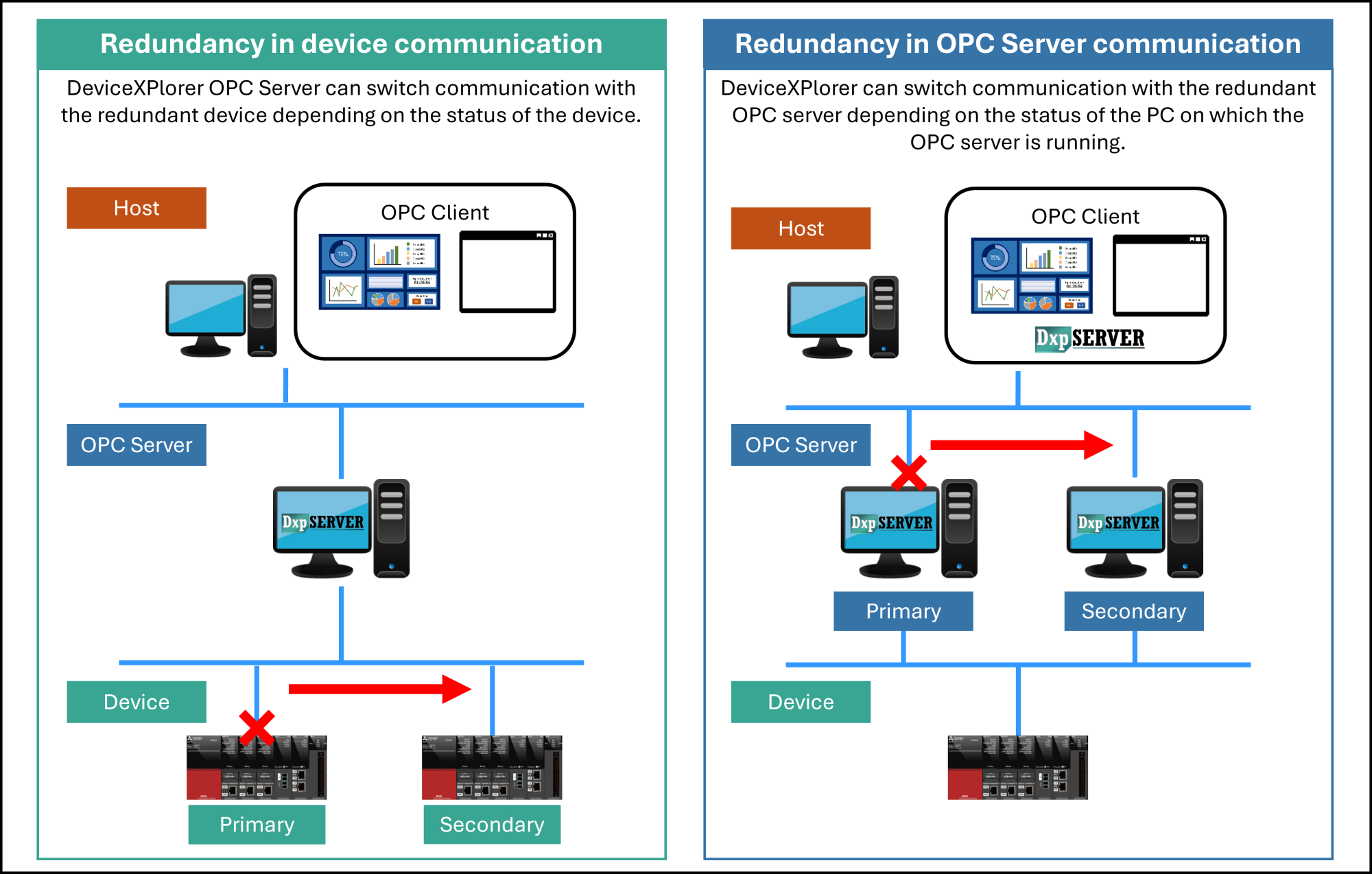
Takebishi’s DeviceXPlorer OPC Server includes redundancy features that maintain continuous data flow even if a device or network link fails. At its simplest, this involves configuring a backup communication path so that when the primary connection to a device fails, DeviceXPlorer OPC Server automatically switches communication to the secondary path. This applies to both the redundant devices and the OPC server itself, meaning DeviceXPlorer can manage redundant communication with other OPC servers.
These options provide a strong foundation for building systems that remain reliable under any conditions.
- The Practical Challenge: Complexity and Maintenance
While DeviceXPlorer OPC Server’s redundancy is powerful and effective, it can be complex to implement and maintain – especially when considering full system redundancy, including OPC systems. Teams must configure multiple servers and devices, coordinate communication paths, and keep configurations synchronized. Over time, updates and changes must be applied consistently across both primary and secondary systems. This requires additional engineering effort and increases the risk of misconfiguration, especially in factories with multiple lines or diverse devices.
- A Simpler, More Resilient Path for OPC systems: DeviceXPlorer OPC Server with Stratus ztC Edge
To reduce complexity while improving availability, combining DeviceXPlorer OPC Server with Stratus ztC Edge is a proven solution.
Stratus ztC Edge from Penguin Solutions Inc. is a secure, rugged, and highly automated computing platform that helps understaffed organizations improve productivity, increase operational efficiency, and reduce downtime risk effectively.
It consists of two redundant nodes functioning as a single system, equipped with self-monitoring and self-protection capabilities. Its zero-touch architecture minimizes operational and maintenance effort, addressing workforce shortages and significantly reducing both operational and maintenance costs through high availability.
Installing DeviceXPlorer OPC Server on Stratus ztC Edge is as straightforward as on a standard PC. There is no need to install it separately on each node. The platform synchronizes CPU and memory data between the two nodes, ensuring that even in the event of a failure, the system continues to operate without downtime.
External OPC client applications, such as SCADA systems, can access it as a single system without awareness of redundancy.
For details on validation and performance results of Stratus ztC Edge with DeviceXPlorer OPC Server, please refer to the full article at the following link:

- Choosing the Right Redundancy Strategy
A redundancy configuration for communication with dual-redundant PLCs and other devices can be achieved by setting up redundant communication paths using DeviceXPlorer OPC Server, while leveraging Stratus ztC Edge for OPC server-level redundancy. This combination reduces configuration complexity and maintenance workload, making it an optimal redundancy solution for modern industrial environments.