Welcome to the compliance corner, here is what is new related to certification of OPC UA and with regards to Certification.
 The Compliance Team of the OPC Foundation has released UACTT Lite, a lightweight tool designed to make information model validation easier for everyone. With a simple interface, it allows users to validate a server against the OPC-released information models the server claims to support. UACTT Lite performs a structured comparison between the expected information model definition (NodeSet) and the actual address space exposed by the server. This “gap analysis” allows users to quickly identify mismatches between specification and implementation, ensuring that information models are implemented consistently and correctly. The tool connects to the server, retrieves its list of namespaces, and validates each namespace against the corresponding released NodeSet. Because each namespace maps to an information model / companion specification, the OPC Foundation has defined more than 160 of them, provides a practical way to confirm that models are implemented correctly. Beyond simple existence checks, the tool performs a comprehensive validation across multiple dimensions. This includes verifying that all expected nodes are present, references between nodes are correct, attributes match the specification, data types are compatible, and type definitions are consistently applied across all instances. This ensures not only completeness, but also structural and semantic correctness of the information model. For example, if a server supports OPC UA for Machinery, UACTT Lite can verify that the OPC UA for Machinery information model is represented correctly against the released NodeSet. It does not test the full functional behavior defined by a companion specification; instead, it confirms that the defined types are represented correctly in the server and that instances based on those types are valid. The tool also checks both mandatory and optional nodes.

Results are presented in a clear and structured manner, distinguishing between elements that passed validation, failed due to errors, or were not supported by design. This allows users to quickly assess compliance, prioritize fixes, and understand whether deviations are intentional or represent implementation issues.
- Developers can use it to verify whether an implementation aligns with the intended information model.
- System integrators can use it to validate the models involved in an integration project.
- End users can use it to confirm that purchased products correctly expose the required information models.
UACTT Lite is particularly valuable across the entire product lifecycle. It can be used during development to detect modeling issues early, during integration testing to ensure compatibility between systems, and during commissioning and maintenance to verify that deployed systems remain compliant with the intended information models.
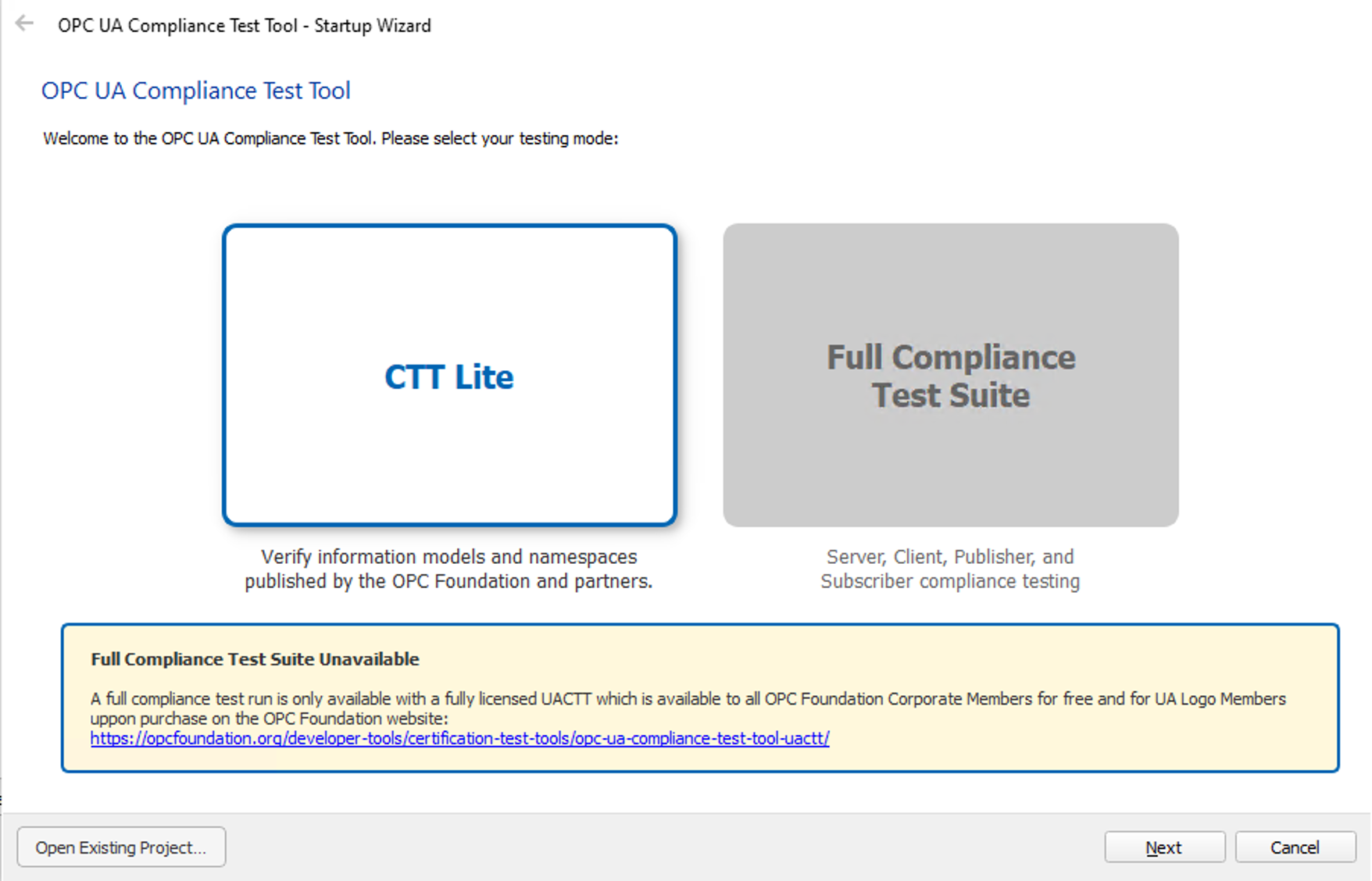 With its simplified configuration and ease of use, UACTT Lite lowers the barrier for validating OPC UA information models and is available free of charge, making it accessible to a wide range of users.
UACTT Lite complements but does not replace the OPC UA CTT. The full OPC UA CTT remains the comprehensive test tool for services, security, core OPC UA functionality, and client and PubSub interfaces. A complete overview of covered functionality is available on the OPC Foundation website. Vendors should use the released 1.05.06 version of the OPC UA CTT, which includes restructured, more granular Conformance Units, broader test coverage, and extended support for OPC UA FX testing.
See the recording of the CTT Lite introduction during the OPC Day International on the OPC Foundation YouTube Channel:
Slides are also available on the OPC Foundation Website: Presentations – OPC Foundation
The OPC Foundation has been working with The Open Group to ensure that we can provided testing for the Open Process Automation forum O-PAS™ standard (OPC UA related aspects). The O-PAS standard is a standard of standards, using and bringing existing standards in context with each other. The standard utilizes OPC UA for communication (OCF) as well as for information modeling. It requires a full range of OPC UA defined functionality (Data Access, Auditing, Roles, AliasNames, GDS …) as well as defining their own information models.
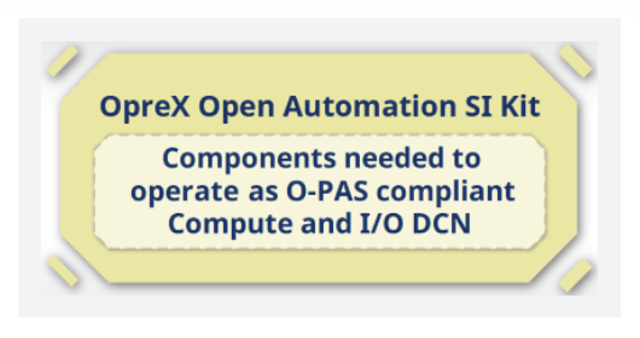 The first O-PAS product has been passed testing by the OPCF Cert Lab. The OpreX Open Automation SI Kit provided by Yokogawa Electric Corporation is a software suite used for building an OPA system. It includes components to make open devices operate as O-PAS compliant “Compute and I/O” DCNs. Yokogawa’s function block library for engineering environments supports IEC61499, which is one of the selected engineering languages in O-PAS.
A key point is that O-PAS requires certification, including testing of OPC UA aspects (certified by the OPC Foundation), ISA 62443-4-2 testing of security-related functionality (certified by ISA 62443 testing bodies), and DMTF Redfish testing, when system management is included. Functionality is organized into profiles. Once all separate profile testing for a product is complete, the product can be certified by The Open Group for the supported profiles.
Just a reminder: Support for certification of OPC UA Version 1.03 products will end at the end of 2026. Vendors should ensure that they are targeting the current OPC UA Version 1.05. The CTT for testing of 1.05 is already available for download from the OPC Foundation Website. The first OPC UA Specifications for version 1.05. were released in 2021 – the specifications, SDK’s and toolkits are stable and ready for implementation.
If you do have questions on these topics or are interested in getting involved in our activities, please do not hesitate to contact us at compliance@opcfoundation.org
Paul & Alexander