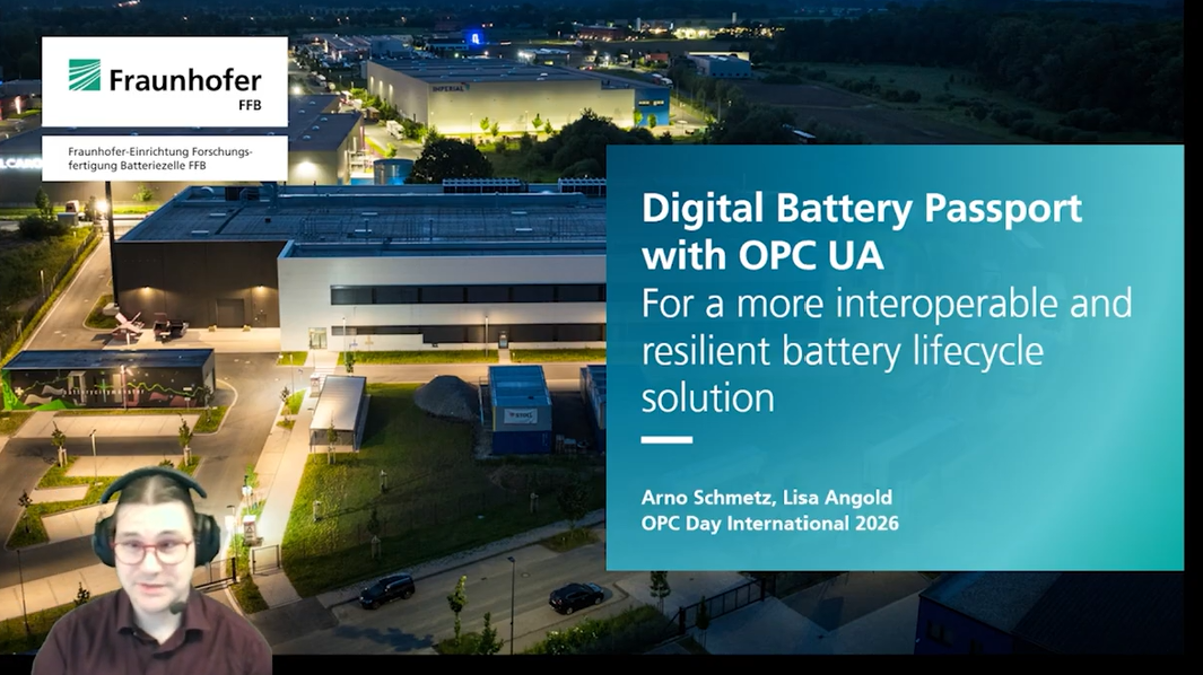
Fraunhofer FFB Demonstrates the Future of Battery Traceability
The European Battery Regulation is transforming the battery industry by introducing one of the world’s first large-scale Digital Product Passport implementations: the Digital Battery Passport. Beginning in 2027, battery manufacturers and economic operators will be required to provide structured, accessible, and trustworthy information about batteries throughout their lifecycle.
At Hannover Messe 2026, the Fraunhofer Research Institution for Battery Cell Production (FFB), together with partners from Catena-X, IDSA, IDTA, OPC Foundation, VDA, and VDMA, demonstrated how OPC UA enables a practical and interoperable implementation of the EU Digital Battery Passport.
The demonstrator highlights an important industry realization: a battery passport is not simply a repository of manufacturing data. To unlock its full value, it must become a digital thread that follows the battery from raw material sourcing and production through operation, maintenance, second-life applications, and ultimately recycling.
Beyond Compliance: A Digital Lifecycle Record
The EU Battery Regulation defines a comprehensive set of information that must be associated with industrial, traction, and light mobility batteries. Required information includes manufacturing details, carbon footprint data, material composition, recycled content, performance metrics, durability information, and end-of-life guidance.
While current regulations primarily focus on collecting company-specific primary data during manufacturing, the industry increasingly recognizes that lifecycle information is equally important. Battery performance, state-of-health, charging behavior, maintenance events, and operational history provide critical insights that determine a battery’s remaining value, suitability for second-life applications, and optimal recycling strategies.
This broader lifecycle perspective transforms the Battery Passport from a compliance obligation into a strategic asset for the circular economy.
The Challenge: Connecting Data Across the Battery Ecosystem
Battery production is among the most complex manufacturing processes in modern industry. From electrode production and cell assembly to formation, testing, and packaging, thousands of process parameters influence battery quality and performance.
These production environments generate vast amounts of valuable information. However, the challenge is not generating data—it is preserving context and making data available across organizational boundaries.
Manufacturers, equipment suppliers, battery operators, recyclers, and regulatory authorities all require access to different subsets of battery information. Without standardized information models and interoperable communication mechanisms, data remains trapped in isolated systems.
This is where OPC UA provides a critical foundation.
OPC UA as the Interoperability Backbone
The Fraunhofer FFB demonstrator showcases how OPC UA connects battery production systems directly to Digital Battery Passport workflows.
Production equipment communicates through OPC UA, enabling machine data, process parameters, quality information, and traceability records to be collected consistently across the manufacturing environment. Through middleware and cloud infrastructures, relevant information is aggregated and prepared for Battery Passport repositories.
More importantly, OPC UA provides semantic interoperability. Data is not exchanged merely as values but with standardized meaning and context. This ensures that information generated by different machines, software systems, and organizations can be understood and reused throughout the battery lifecycle.
The demonstrator addresses several key challenges:
- Interoperability between different Battery Passport solutions
- Standardized exchange of production and quality data
- Secure authorization and authentication mechanisms
- Management of dynamic lifecycle information
- Integration of manufacturing and operational data
By leveraging OPC UA information models, partners can exchange information without requiring proprietary integrations or vendor-specific interfaces.
Digital Battery Passport modelling with OPC UA
Modeling Digital Battery Passports with the broad OPC UA ecosystem brings immediate practical advantages: instead of inventing yet another isolated data schema, stakeholders can build on mature OPC UA information-modeling methods, reusable companion specifications, standardized NodeSet artifacts, validation workflows, and code-generation tool chains that are already widely used across industrial automation. This shortens development time, significantly reduces cost, improves semantic consistency across vendors and software stacks, and makes it much easier to connect manufacturing, test, usage, service, and recycling data into one interoperable digital thread. Just as importantly, the existing and vast OPC UA tooling landscape helps domain experts, standards groups, and implementers collaborate on models that are easier to govern, extend, and implement at scale. It also enables leveraging the existing and well-established services released by the OPC Foundation for storing OPC UA Information Models like the UA Cloud Library as a cost-effective storage and access point for Digital Battery Passports.
From Shop Floor to Circular Economy
A Digital Battery Passport begins on the shop floor, where manufacturing data establishes the battery’s digital identity. Information such as production parameters, material provenance, carbon footprint calculations, and quality records forms the foundation of the passport.
However, the real value emerges when this information is continuously enriched during the battery’s operational life.
As batteries are deployed in vehicles, industrial equipment, or energy storage systems, additional lifecycle data can be linked to the passport. State-of-health information, usage history, maintenance records, and performance indicators provide an evolving picture of the battery’s condition.
This lifecycle view enables:
- More accurate valuation of used batteries
- Improved decisions for repair and reuse
- Reliable qualification for second-life applications
- More efficient recycling processes
- Enhanced transparency for regulators and consumers
The result is a true digital product passport that supports the entire circular economy.
An Open Ecosystem for the Future
The OPC Foundation’s work on Digital Product Passports extends beyond batteries. Through collaboration with CEN, CENELEC, Catena-X, IDSA, and numerous industry partners, OPC UA is becoming a foundational technology for future Digital Product Passport implementations across multiple industries.
The Battery Passport serves as the first large-scale proof point. The lessons learned from battery production, lifecycle tracking, and circular economy requirements will provide a blueprint for Digital Product Passports in many other product categories.
As demonstrated by Fraunhofer FFB and its partners, open standards are essential for success. Interoperability cannot be achieved through isolated solutions. It requires a common semantic framework that connects machines, manufacturers, operators, service providers, and recyclers throughout the product lifecycle.
OPC UA provides exactly that foundation—enabling Digital Battery Passports that are not only compliant, but truly interoperable, scalable, and capable of supporting the next generation of sustainable industrial ecosystems.
Get more information here
Listen to the recording: https://youtu.be/JuWt-48btr4
Download the presentation here Presentations – OPC Foundation